The Psychology Behind Self-Doubt
The Psychology Behind
Self-Doubt: Why It Happens and How to Rebuild Self-Trust
Self-doubt rarely announces itself loudly. The psychology behind self-doubt is not about dramatic insecurity or visible hesitation. More often, it shows up quietly through overthinking, over preparing, and over giving.
If you are the reliable one, the responsible one, the one others count on, you might still carry an internal whisper that asks:
“Did I say that right"?”
“Should I have handled that differently?”
“Why does everyone else seem more certain than me?”
The psychology behind self-doubt shows us something important. Self-doubt is not a personality flaw. It is a learned pattern shaped by experience, reinforced by repetition, and maintained by pressure.
And what is learned can be unlearned.
The Psychology Behind Self-Doubt:
How It Actually Forms

No one is born second guessing their worth.
The psychology behind self-doubt tells us this pattern develops gradually, often in environments where performance was praised more than authenticity. Maybe you were celebrated for being capable, helpful, or high achieving but not always for expressing uncertainty, emotions, or independent preferences.
Self-doubt can grow from:
Subtle or repeated criticism
Inconsistent feedback
High expectations without emotional support
Comparison to siblings, peers, or colleagues
Praise focused only on achievement
Over time, your brain internalizes a protective message:
Be careful. Do not get it wrong. Seek approval first.
From a psychological perspective, this makes sense. According to the American Psychological Association, our brains are wired to prioritize belonging and safety. If approval once equaled safety, your nervous system learned to monitor and adjust constantly.
At first, this internal voice feels responsible and protective.
But eventually, what began as protection becomes limitation.
You hesitate before decisions.
You replay conversations.
You delay opportunities.
The issue is not competence. It is that your internal compass was trained to look outward before looking inward.
Why Self-Doubt Persists Even When
You Are Successful

One of the most misunderstood parts of the psychology behind self-doubt is this. It often persists in high functioning, capable individuals.
Self-doubt thrives in two conditions:
Pressure to perform, please, or be perfect
Disconnection from your internal cues, limits, and emotional needs
When pressure and disconnection combine, confidence becomes conditional.
You feel steady when feedback is positive, expectations are clear, and everything feels controlled.
But when circumstances shift, uncertainty rises and your certainty shifts with it.
Research from Harvard Health Publishing explains that chronic stress and perfectionism activate threat responses in the brain. When the nervous system is on alert, self-trust decreases.
You are not too sensitive.
Your nervous system is trying to stay safe.
This is why simply telling yourself to be confident does not work. Confidence that is forced collapses under stress. Sustainable self-trust feels grounded and internal.
The Psychology Behind
Self-Doubt and the Nervous System
Self-doubt is not only cognitive. It is physiological.
When you question yourself repeatedly, your body responds. Tight chest. Overanalyzing. Difficulty deciding. Tension in your shoulders. That is your nervous system scanning for potential mistakes.
According to Cleveland Clinic, repeated self criticism activates stress hormones that reinforce anxiety loops.
This creates a cycle:
You feel unsure
You overthink
You feel stressed
Stress increases self-doubt
Breaking this cycle requires more than positive thinking. It requires awareness and repetition in the same way the pattern was built.
Shifting Self-Doubt Where
Real Change Begins

The psychology behind self-doubt teaches us that forcing confidence does not work. Fake it until you make it often strengthens the very pattern you are trying to undo.
Pressure does not dissolve doubt. It amplifies it.
The shift begins through awareness and self compassion.
Instead of asking what is wrong with me, try asking where did I learn to respond this way.
That question moves self-doubt out of identity and into history.
And once something is historical, it becomes changeable.
Progress happens in small, practical ways:
Pause before automatically saying yes
Let a task be good enough instead of perfect
Trust your first instinct in low stakes decisions
Honor a boundary instead of overriding it
These are quiet but powerful signals to your nervous system that it is safe to listen to yourself again.
Why Repetition and Structure
Rewire Self-Doubt
Insight feels powerful but repetition rewires patterns.
The psychology behind self-doubt shows that it formed through repeated experiences. Self-trust is built the same way.
Many people try to change all at once. They journal intensely for a week, set huge goals, and expect transformation.
Sustainable change looks different:
Consistent reflection
Small boundary shifts
Reframing inner dialogue
Reconnecting with body cues
When practiced together, confidence begins to feel accessible rather than manufactured.
You do not have to eliminate self-doubt entirely.
You only need to learn how to stay connected to yourself when self-doubt appears.
That is a skill and skills can be strengthened.
Signs Your Self-Doubt Is Really
About Self-Trust
Sometimes the psychology behind self-doubt is less about insecurity and more about disconnection.
You might struggle with self-trust if you:
Constantly seek reassurance
Replay conversations afterward
Feel confident until feedback changes
Override your own limits to avoid disappointing others
Feel responsible for managing others emotions
Self-trust is quiet steadiness.
It says;
I can handle discomfort
I can make adjustments without collapsing
I do not need to be perfect to be worthy
Key Takeaways
Self-doubt is learned, not inherent
It often forms in high expectation environments
It is reinforced by pressure and perfectionism
It is maintained through nervous system stress
It shifts through awareness, repetition, and self-trust practices
You are not broken.
You are patterned.
And patterns can change.
Start Rebuilding Self-Trust Today
Shifting self-doubt starts with small, consistent moments of awareness.
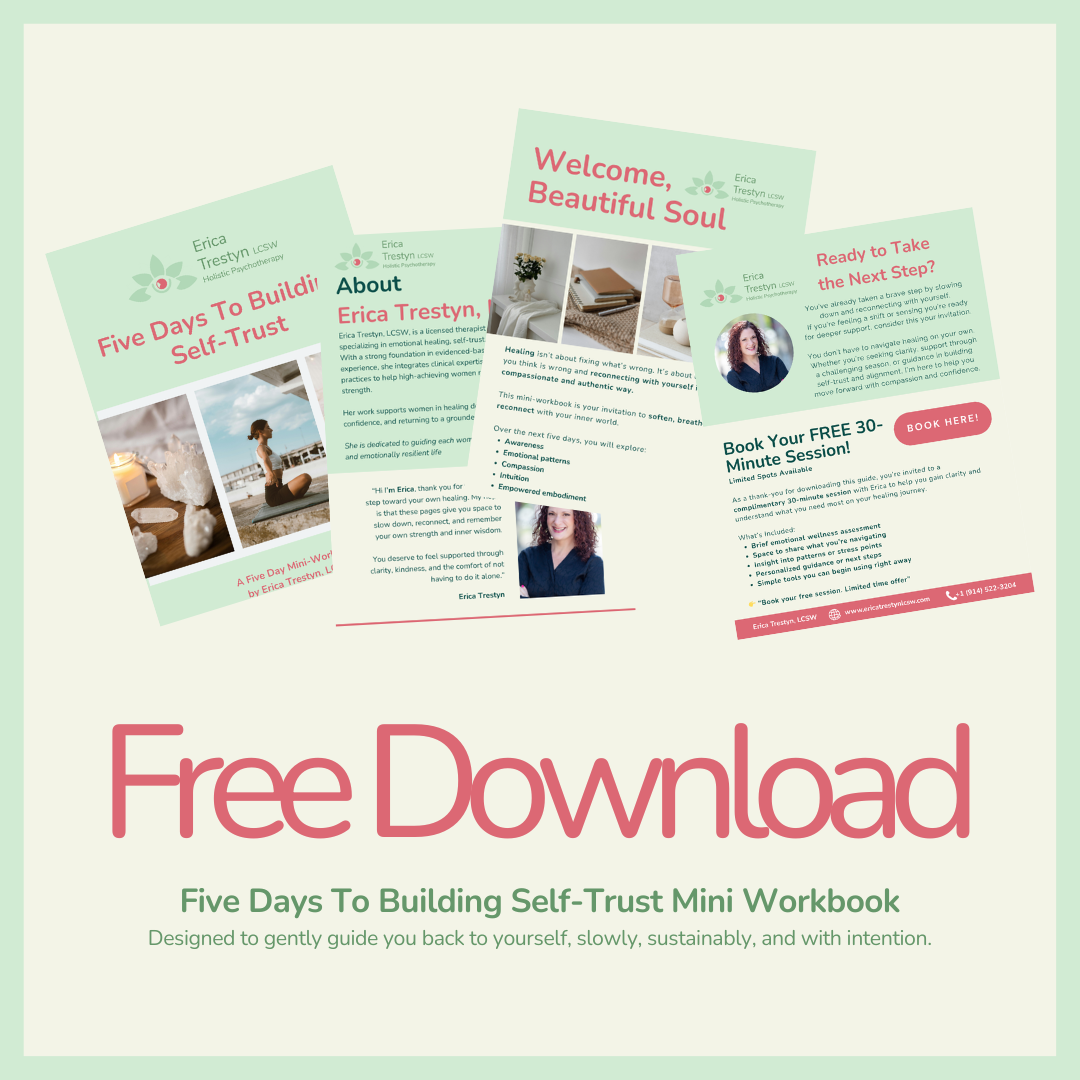
If you would like structure to begin, you are invited to download The 5 Day Self-Trust Mini Workbook, a guided resource designed to help you reconnect with your inner voice and practice self-trust in everyday life.
If you have questions or would like to inquire about working together:
You do not have to eliminate every doubt to feel secure.
You only need to learn how to stay connected to yourself when self-doubt appears.
And that is something you can build over time.